Showing posts with label Kyushu. Show all posts

Tuesday, February 14, 2023

Yuzukosho Spice of Kyushu

Yuzukosho (柚子胡椒) - The Spice of Kyushu

by Johannes Schonherr
Yuzukosho (柚子胡椒) - The Spice of Kyushu.
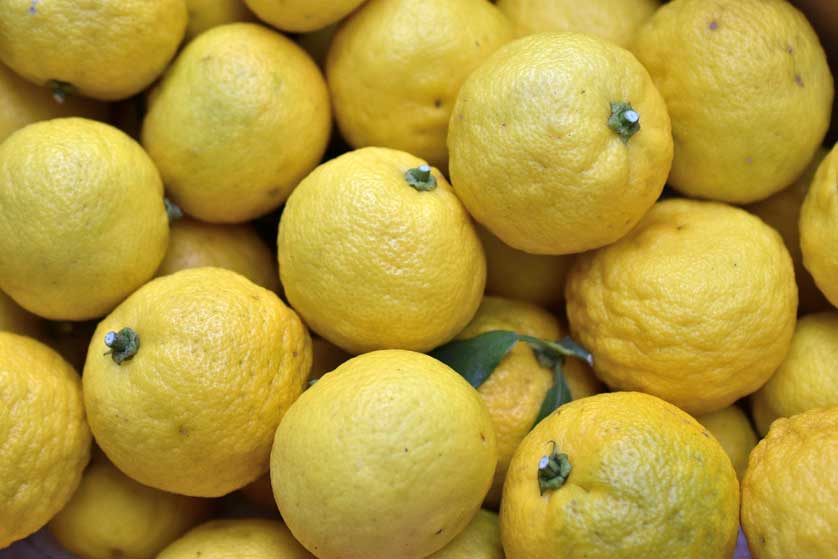
Yuzu fruits

Yuzu are a citrus fruit famous for their strong fragrance, grown mainly on the southwestern Japanese islands of Kyushu and Shikoku.

Yuzukosho (yuzu pepper) is a paste made of yuzu peel, green chili pepper, salt and a bit of yuzu juice which has been traditionally used in nabemono hot pot soups, typically eaten in winter.

Nowadays, the variety of use for yuzukosho as an ingredient has spread far and wide: from various Japanese soup dishes like udon and soba to yakiniku barbecue to steak seasoning. Some adventurous restaurants serve their sushi and sashimi with yuzukosho rather than wasabi.

Western chefs have also picked up on yuzukosho as an exotic yet multi-purpose spice, enlivening their creations with an earthy yet highly refined note.
Yuzu (柚子) are a winter fruit in Japan

Yuzu Fruits

Buy a premium quality yuzu at a farm in Kyushu or at a department store elsewhere in Japan and take it out of its protective plastic cover.

The fragrance of the fruit quickly fills the room.

That's why it is an old Japanese custom to let a few yuzu swim in the onsen hot spring bath water on a winter solstice night: yuzu being a winter fruit, it brings out the best of the smells of the season.

Cut open the fruit and you will be bit disappointed: plenty of seeds embedded in rather loose flesh. Very little juice can be extracted from a single fruit.

It is the outer yuzu peel that is precious. That's the part of the fruit responsible for the fragrance. Cut the outer, yellow peel off a ripe fruit and you will find it to be a delicious ingredient in soups, salads, pasta or meat dishes.
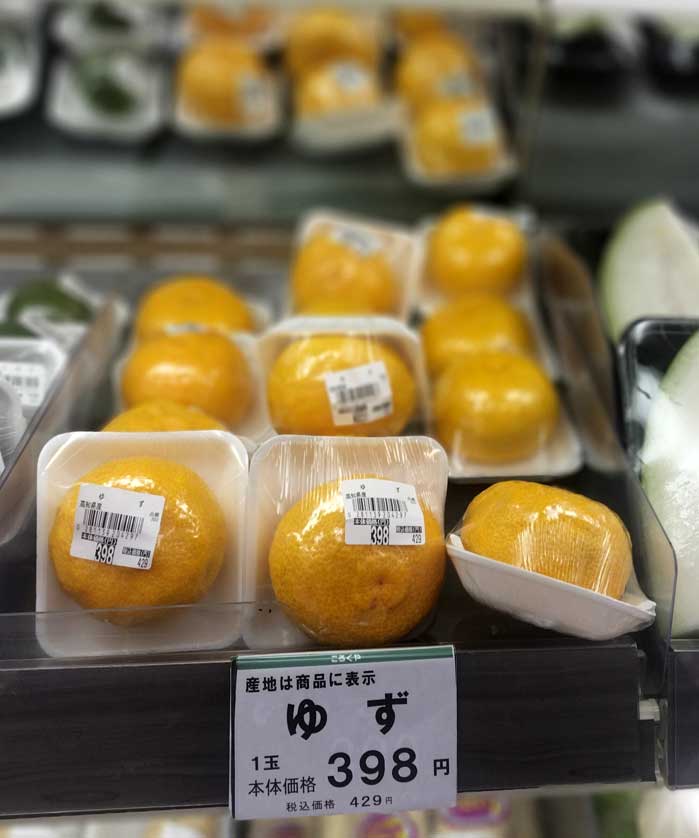
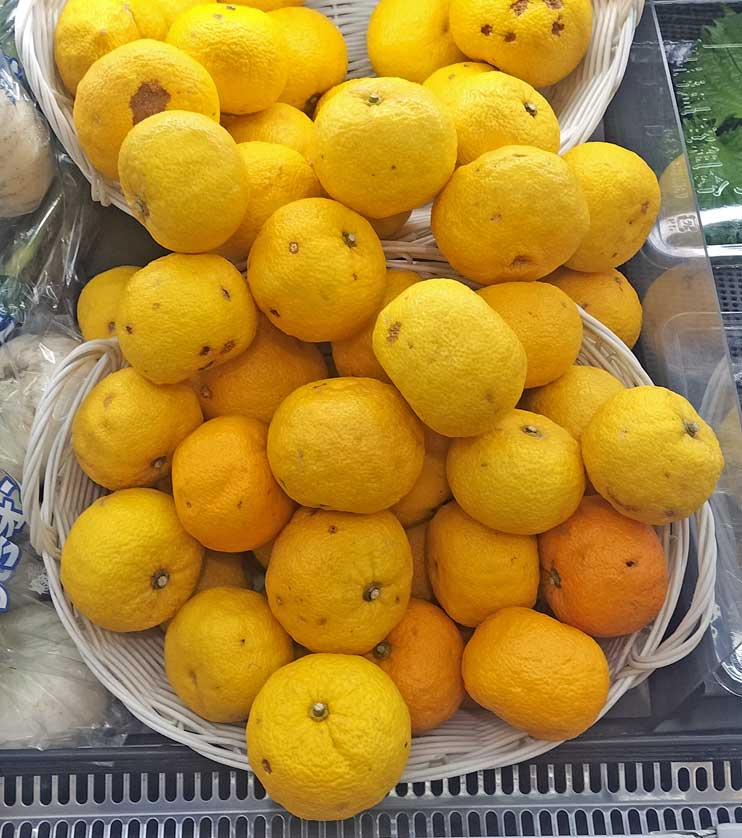
Yuzu on sale at a Japanese supermarket.
Yuzu on sale at a Japanese supermarket

Fresh yuzu fruits can be a bit hard to come by outside of Japan, however.

A limited amount of yuzu is grown in California, for example, but as food writer Helen Rosner stated in an article for The New Yorker in February 2020 aptly titled Nothing Compares to Yuzu, "the U.S.D.A. [United States Department of Agriculture] has a ban on the import of fresh yuzu from abroad - the fruit and the trees." After lamenting the high prices for yuzu on the U.S. East Coast, she continues saying, "I'm told that, among New York chefs, there is a thriving black market in fresh yuzu smuggled from Japan."

Yuzukosho however can freely be shipped from Japan to the U.S. and anywhere else. Goods from Japan is an easy and reliable source.
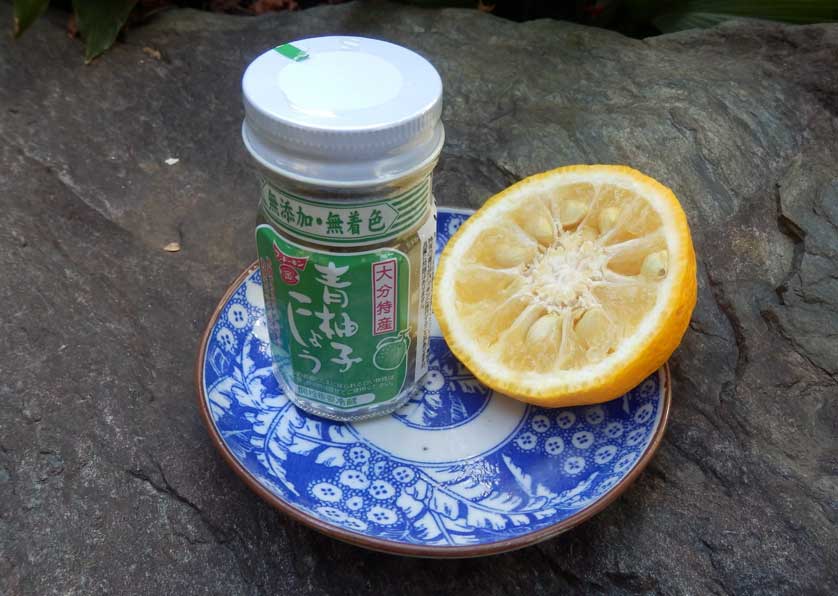
Yuzu fruit and Yuzukosho.
Yuzu fruit and Yuzukosho

Yuzukosho

So, what exactly is yuzukosho? Yuzukosho is a fermented paste made up of the peel of unripe green yuzu, green chili pepper, salt and a bit of yuzu juice.

It contains all the fragrance of the yuzu, it is spicy, can be used for a wide variety of purposes (you might want to experiment with it a bit) and it remains in good, fresh condition for a very long time.

The origin of yuzukosho is central-northern Kyushu. Around the city of Hita in Oita Prefecture, about halfway between the Pacific coast and Fukuoka, farmers have made yuzukosho for centuries. Mainly for their own private use though some of the specialty certainly found its way to the markets of bustling Hita, known in the Edo Period as the Kyoto of Kyushu.

Yuzukosho remained a decidedly local spice of northern Kyushu well into the 1990s, sold at souvenir shops in Yufuin and other hot spring resorts as a sort of unique local gift to take home to friends.

Fundokin Green Yuzukosho

Things changed in the late 1990s when Fundokin, a major maker of miso paste and shoyu (soy sauce), based in the old coastal samurai town of Usuki, just south of Oita City, began to sell and promote yuzukosho on a national level.

Suddenly, yuzukosho became available in stores all over Japan. Chefs in Tokyo and elsewhere took notice and incorporated the spice into their dishes. Snack makers came up with yuzukosho rice crackers, yuzu fruit cakes - if you look out for anything yuzu in any Japanese supermarket, you will find a wide variety of yuzu and yuzukosho products.
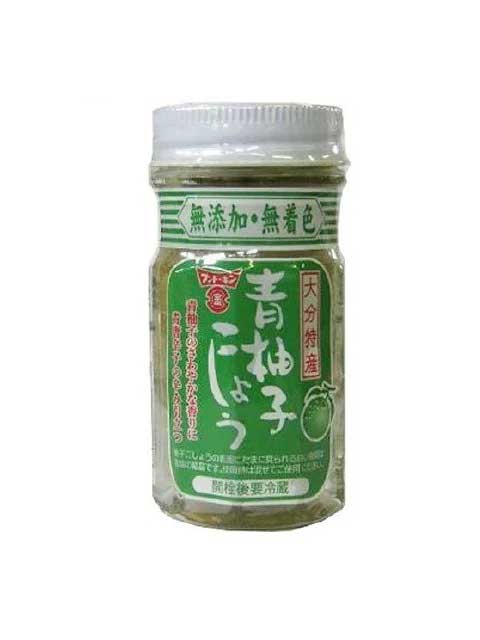
The original Fundokin Green Yuzukosho, produced in Usuki, Oita.
The original Fundokin Green Yuzukosho, produced in Usuki, Oita

Purchase

The original Fundokin Green Yuzukosho, produced in Usuki, Oita without using any additives is conveniently available in the food section at Goods from Japan.

Related

Ema Votive Plaques

Calpis

Cedar Leaf Incense

Cheese Tara

Furikake Tsukudani Rice Topping Kinshobai

Growing Your Own Food in Greater Tokyo

Hoshigaki

Ishigaki Sea Salt

Japanese Chocolates

Japanese Mortar & Pestle Suribachi & Surikogi

Jinbei & Samue

Kabosu Juice

Katsuobushi

Kombu Japanese Kelp

Sancho

Sayama Japanese Green Tea

Shichimi Togarashi Seven Spices

Yatsuhiro & Tatami

© GoodsFromJapan

Friday, April 01, 2022

Yatsushiro and Tatami Goza Kyushu Japan

Yatsushiro and Tatami 畳

Jake Davies

The skyline of Yatsushiro, Kumamoto, an unlikely setting for one of Japan's unique cultural products.
The skyline of Yatsushiro, Kumamoto, an unlikely setting for one of Japan's unique cultural products

Yatsushiro is a small city on the coast of Kumamoto Prefecture in central Kyushu. Located at the mouth of the Kumagawa River where it empties into the sea across from the Amakusa Islands, it is not a well-known tourist destination and for most is just glimpsed out of the Shinkansen window.

Once home to a small castle, the town's major landmarks now are the chimneys and industrial structures of a large paper mill. North of the town is a flat, coastal plain covered in fields and paddies dotted with small farming settlements, and it is from here that Yatsushiro produces what is arguably its most important crop, igusa, the type of rush that is used in tatami mats, and of which Yatsushiro produces a full 90% of all that is now produced in Japan.

Tatami mats, the traditional Japanese flooring that was originally only for the elite and wealthy.
Tatami mats, the traditional Japanese flooring that was originally only for the elite and wealthy

Uniquely Japanese

Tatami are the rectangular mats that cover floors in traditional Japanese homes and spaces. They are a uniquely Japanese product, unlike so many that actually have their origins in China or Korea. If Japan had imported the chair from China then maybe tatami would not have even been invented.

In the Heian Period (794-1185) most Japanese homes had dirt floors with straw mats. The wealthy, however, had wooden floors, and tatami was used for seating. By the Muromachi Period (1336-1573), the use of tatami had become more widespread and by now whole rooms would be covered in tatami. By the late 17th century the use of tatami had spread to many commoners' houses.

Small, local tatami workshops still can be found in many towns.
Small, local tatami workshops still can be found in many towns

Tatami Parts

There are three parts to a tatami mat: tatami-doko, tatami-fuchi, and tatami-omote. Tatami-doko is the bulk of the mat, the interior. Traditionally it was compressed rice straw, but nowadays foam, wood-chips, and other materials are often used, sometimes in combination with straw. Tatami-fuchi is the woven brocade strips that cover the edges of the mat. These are woven in a variety of standard designs. Tatami-omote, is the surface of the mat, the woven strands of igusa, and it's from the Yatsushiro area that most of the Japanese igusa now come from.

Flooded paddy in December being prepared for igusa planting.
Flooded paddy in December being prepared for igusa planting

Igusa

Igusa (pronounced igsa, the u is very weak), Juncus effusus, is known as soft rush or common rush in English. It grows naturally throughout the Japanese islands, and is actually found growing over most of the world. Its natural habitat is near water, on river banks, marshy land, etc. As the use of tatami mats spread, the Japanese began to cultivate it, and about 500 years ago the daimyo of Kumamoto gave a license to produce igusa to 5 villages in the Yatsushiro area. In the Meiji period restrictions on who could grow igusa were lifted, but whereas nowadays there is little igusa grown in most of Japan, igusa production flourishes in the Yatsushiro area.

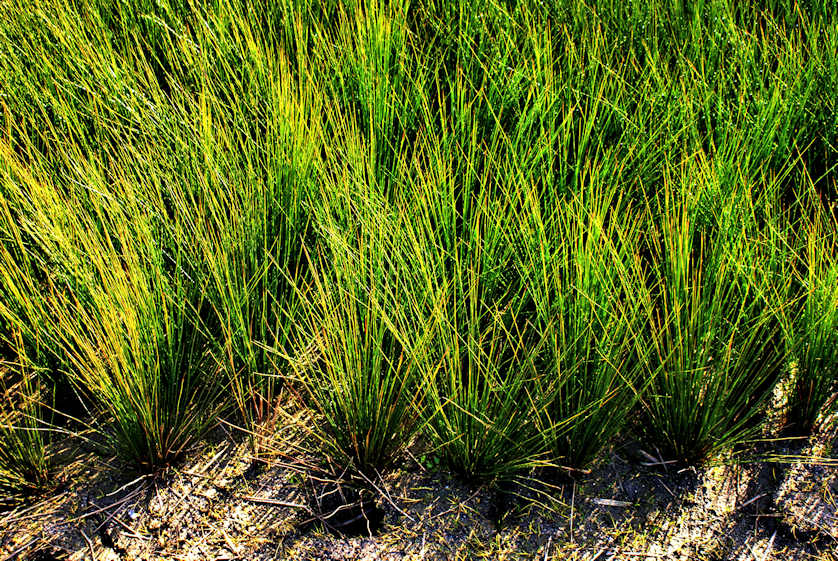
Young igusa shoots growing in paddies near Yatsushiro, Kumamoto. Virtually indistinguishable from a rice paddy.
Young igusa shoots growing in paddies near Yatsushiro, Kumamoto. Virtually indistinguishable from a rice paddy

Paddies

Igusa is grown in flooded paddies, in a similar way to rice, though the seasons are almost opposite. Igusa is panted in late Autumn to early Winter, after the rice has been harvested. The small machines used in the planting and harvesting of igusa are variations on the same machines used for rice. In the Spring a net is stretched over the paddy so that as the plant grows tall the net supports it and stops wind damage. The igusa is harvested in the peak of Summer when it has grown to up to a meter and a half tall.

The growing igusa plants will soon need a supportive net.
The growing igusa plants will soon need a supportive net

Processing

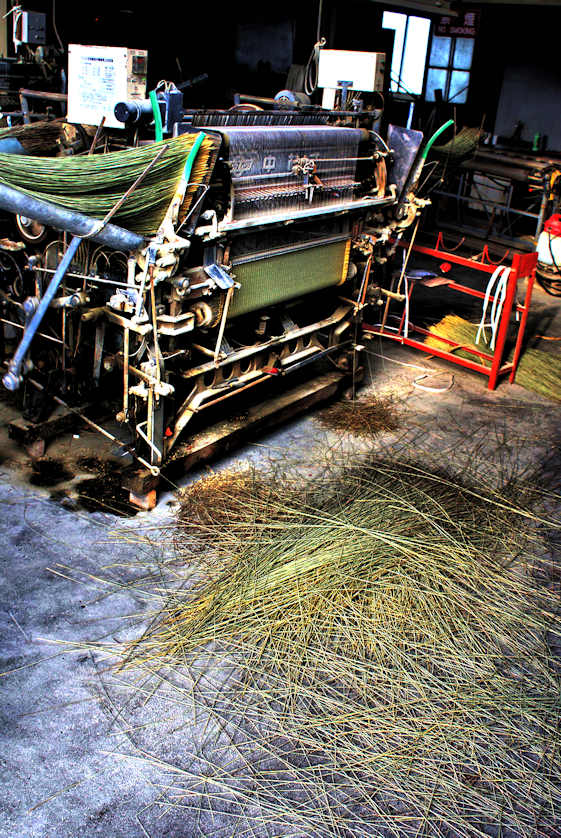
After harvesting, the same farming families that grew the igusa also do the processing. First the igusa is dried and then stored in dark conditions. This enables the retention of the light-green color typical of a new tatami mat. Though igusa is only harvested once a year, the weaving of the mats goes on pretty much all year round. Every small village will have several workshops where the "chaka-chaka-chaka" of machinery can be heard. The igusa straw is first graded, then trimmed, and finally woven into mats ready for tatami-makers throughout the country.

Dried igusa is trimmed and cut to length.
Dried igusa is trimmed and cut to length
The first mechanical looms for weaving igusa into tatami were invented in the 1930s.
The first mechanical looms for weaving igusa into tatami were invented in the 1930s
The final product waiting to be shipped to a tatami maker.
The final product waiting to be shipped to a tatami maker

Purchase Tatami from Japan

Purchase a selection of tatami products from GoodsFromJapan

Japan SIM Cards From Mobal

Get a Japan SIM Card from Mobal

Related Articles on Japan

Daruma Dolls - History & Symbolism

Ema Votive Plaques

Hand Painted Candles

Ishigaki Sea Salt

Japanese Masks

Shichimi Togarashi Seven Spices

Yanai Goldfish Lanterns

Yuzukosho Spice of Kyushu

© GoodsFromJapan.com