Thursday, July 23, 2026

Growing Your Own Food in Greater Tokyo

Growing Your Own Food in Greater Tokyo 市民農園

Growing Your Own Food in Greater Tokyo.

Let's face it: Greater Tokyo is a concrete jungle, home to some 33 million people packed onto trains and crowded streets. Yet hidden among the skyscrapers and suburbs is an unexpected opportunity - you can rent a small plot of land and grow your own vegetables and flowers.

According to the Tokyo Metropolitan Government, hundreds of community garden plots are available throughout Tokyo for residents who want to try their hand at farming, subject to a few simple rules.

If you live outside Tokyo, you don't have to miss out. Similar programs exist in Kanagawa, Chiba, Saitama, Aichi, Hyogo, Kyoto, Osaka and Fukuoka. One useful resource is Share Batake (https://www.sharebatake.com), which lists rental gardens in many parts of Japan.

There are two main types of rental gardens. The first is shimin noen (市民農園), or "citizen farms." These are do-it-yourself plots where you rent the land and are responsible for everything—from selecting seeds/seedlings to deciding what to plant and when. You provide your own tools and make all cultivation decisions.

The second type is nogyo taiken noen (農業体験農園), or "agricultural experience farms." Here, a professional farmer manages the site, provides instruction, and follows a planting schedule with participants. These gardens are particularly popular with beginners.

When my wife and I bought a house in Ichikawa, Chiba, two years ago, we applied for a four-meter-by-four-meter plot in a citizen garden. We told the city we were complete novices. My wife grew up in Tokyo, and I grew up near San Francisco.

Growing Your Own Food in Greater Tokyo.

"Don't worry," we were told. "The veterans will help you."
They were right.

Several experienced gardeners have loaned us tools, shared advice on what grows best in our area, and patiently answered our questions. Although I've never actually caught them in the act, I'm convinced that some of our neighbors occasionally weed our plot and even leave fertilizer behind anonymously.

Our garden also has a charming old hand-crank water pump, so we never have to haul water from home.

The eligibility requirements are straightforward. You must live in the municipality, agree to follow the garden's rules, maintain your plot, and use it to grow food or flowers for personal enjoyment rather than commercial purposes. Most municipalities also limit rentals to one plot per household.

Plots are typically between 10 and 20 square meters. Annual fees for do-it-yourself gardens are generally around ¥10,000. We pay ¥8,000 a year, although I know of one fully managed garden in Tokyo that charges ¥65,000 for a 22-square-meter plot available for ten months of the year. Rental terms usually range from one to three years. Because of the relatively short leases, growing fruit trees is generally prohibited.

Growing Your Own Food in Greater Tokyo.

Demand is high, and many municipalities allocate plots through a lottery system.

In just two years, we've harvested tomatoes, strawberries, green shiso, shishito peppers, watermelons, melons, peanuts, cucumbers, garlic, green peppers, leeks, onions, zucchini, paprika, goya and several varieties of eggplant.

If you're interested in finding a garden of your own, these websites are good places to start. Some are available only in Japanese.

You may be surprised to discover that, even in one of the world's largest metropolitan areas, there's still room to dig in the dirt and harvest dinner.

Bon appétit.

Tomatoes.

By Marshall Hughes, author of Rural Reflections: What 11 Years in Provincial Japan Taught Me.

Looking to buy Japanese things directly from Japan? GoodsFromJapan is here to help.

Japan Book Reviews

All About Japan - Stories, Songs, Crafts and Games for Kids

Exposure: From President to Whistleblower at Olympus

Japanese Kokeshi Dolls: The Woodcraft and Culture of Japan's Iconic Wooden Dolls

Japanese Dolls: The Fascinating World of Ningyo

Rural Relections

The Snow Woman

Tokyo Outdoors

Tuesday, July 21, 2026

Katsuobushi & Katsuobushi Kezuriki

Bonito Flakes in the Kitchen: Katsuobushi and the Katsuobushi Kezuriki 鰹節と鰹節削り器

Katsuobushi fillet and katsuobushi kezuriki.
Katsuobushi fillet and katsuobushi kezuriki

Remember the first time you were served okonomiyaki (Japanese pancakes) in one of those dark, dingy, tiny but homely restaurants in Osaka? The first time you received a boat of takoyaki (wheat batter balls containing a piece of octopus)? Did you wonder what those wildly fluttering flakes on top of the dish? Those flakes almost seem to have a life of their own! It's the heat of the dishes underneath that makes them vibrate.

Those flakes are called katsuobushi and you encounter them in Japan quite frequently and in many different ways. They are used as soup stock, mixed with rice in onigiri rice balls and as topping on an endless variety of dishes ranging from tofu to soba noodles to meat (especially chicken), more recent recipes even include them as toppings on avocado and other imported foods.

Katsuobushi fillets from GFJ.
Katsuobushi fillets

What is Katsuobushi?

Now, what are those katsuobushi? Roughly translated, katsuobushi means dried bonito flakes. Katsuo is the Japanese name for the skipjack bonito, a fish belonging to the tuna family.

The best meat of those fish, usually caught in the waters surrounding southern Japan, is filleted by hand and knife. Work that needs quite some skill. An experienced worker cuts the fillets from the fish in less than a minute.

Those fillets are then simmered close to the boiling point for an hour or more, then wood smoked up to a month. A smoking session lasts about six hours, then the fillet rests for a day. This process is repeated for about 12 to 15 times. Finally, the fillet is sun-dried for about two weeks with the help of a special mold, the Aspergillus glaucus. The mold ferments the fillet and removes any residual moisture.

When ready for sale, those fillets are hard as wood and brown on the outside, resembling short sticks of firewood. On the inside, they are a blackish purple. After scraping a section of the fillet, the exposed parts glisten in the light like dark, colored glass.

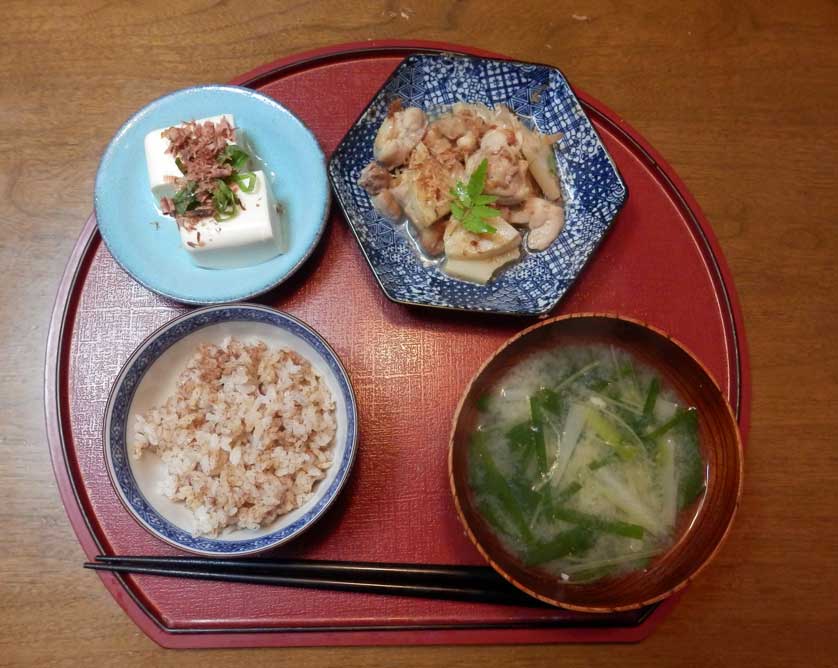
Katsuobushi-centered meal. Katsuobushi-topped tofu, katsuobushi-topped bamboo sprouts, rice mixed with katsuobushi, miso soup using katsuobushi stock.
A katsuobushi-centered meal: katsuobushi-topped tofu, katsuobushi-topped bamboo sprouts, rice mixed with katsuobushi, miso soup using katsuobushi stock

History

Dried bonito is as old as Japan. The most ancient books refer to it as do the legends of the Ainu, the original inhabitants of the islands. Dried bonito could be stored for a long period, it was easy to transport, it was very nutritious and it was very tasty when mixed with rice. That ancient dried bonito was however not the same as the katsuobushi flakes in use today.

Those were invented by a man named Jintaro Kadoya in the Kumano domain (today's Wakayama Prefecture) in the mid-1600s. Kadoya came up with the concept of fumigating the katsuo fillets to preserve them in the best possible way.

Not finding the success with his invention he had hoped for in his native Kumano, Kadoya moved to the Tosa domain on the southern shore of Shikoku (today's Kochi Prefecture). There, the bonito catches were better and the locals embraced Kadoya's production method.

Producing katsuobushi in Tosa proved to be very challenging, however. The climate was wet and mold easily settled on the fillets when set out for sun-drying.

But soon, the Tosa locals producing katsuobushi in Kadoya's way learned how to deal with that ever pervasive mold. They incorporated the mold into the production process, turning the mold from a nuisance into the final step of refinement.

Tosa katsuobushi soon became all the rage on the markets of Edo and Osaka.

The production process was a closely guarded secret but that secret soon leaked out to the Satsuma domain (today's Kagoshima Prefecture). Production conditions in Kagoshima were very similar to those of Tosa (Kochi).

Katsuobushi kezuriki.
Traditional katsuobushi kezuriki

Famous Production Areas

Kochi and Kagoshima Prefectures are still the main producers of katsuobushi today. They got the brand name recognition, they got the history and the experience of family-run firms dealing with the product for centuries.

Shaving the Katsuobushi

Most common today are factory-shaved katsuobushi flakes. Those are sold in plastic bags in all Japanese supermarkets and they are the most easy to use.

It’s more fun, though, to produce the katsuobushi flakes in your kitchen by yourself. To do so, you need a special tool to shave the flakes from the wood-like katsuobushi fillet.

Traditionally, for this purpose a katsuobushi kezuriki is used. Essentially, that’s a wooden box with a blade inserted. You move the katsuobushi fillet with a certain amount of strength over the blade functioning as a sort of wood plane. The shaved-off flakes are collected in the drawer below the blade.

Working the blade needs a certain amount of practice, though. You need to figure out how exactly to hold the fillet stick and what amount of pressure to apply. If done incorrectly, the result of the shaving will be rather a reddish rough powder than the desired flakes.

That powder is delicious and can be used in salads, for example. But you wanted the flakes, right? The real thing.

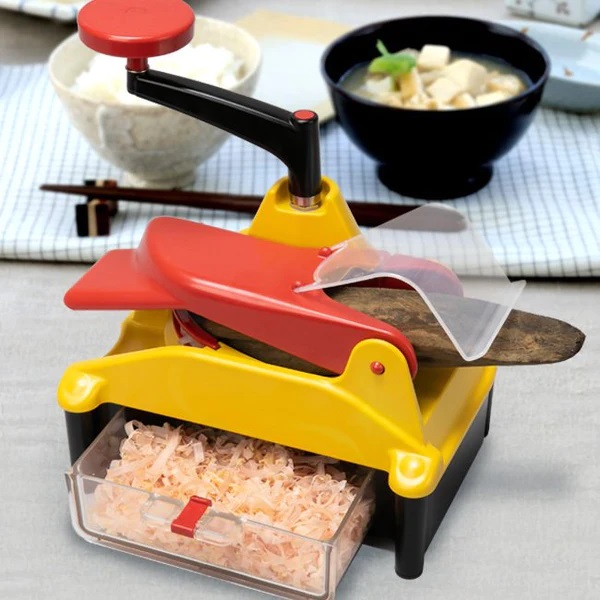
Those can be more easily produced using a mechanic katsuobushi shaving machine. Of course, the mechanic shaver leaves you a little short on the experience of cooking in real traditional Japanese style but it provides you with the desired result easily and efficiently.

Katsuobushi fillet and katsuobushi kezuriki.
A katsuobushi fillet and katsuobushi kezuriki

Buy Katsuobushi

Goods from Japan offers all the options, the wood-like fillet sticks and the old-style kezuriki as well as two kinds of mechanic shavers, one named the Okaka and the other the Kakuta-Kun, and of course, the most easy-to-use bagged factory-made katsuobushi flakes.

Purchase a range of Japanese foodstuffs and drinks from GoodsFromJapan.

Japan SIM Cards From Mobal

Get a Japan SIM Card from Mobal

Related

Calpis

Cedar Leaf Incense

Ema Votive Plaques

Furikake Tsukudani Rice Topping Kinshobai

Growing Your Own Food in Greater Tokyo

Happi Coats

Ishigaki Sea Salt

Japanese Chocolates

Japanese Mortar & Pestle Suribachi & Surikogi

Kaki no Tane

Kombu Japanese Kelp

Masu Wooden Sake Boxes

Ramune

Sancho

Sayama Green Tea

Shichimi Togarashi

Yanai Goldfish Lanterns

Yatsuhiro & Tatami

Yuzu Kosho Spice from Kyushu

by Johannes Schonherr

Katsuobushi Shaving Machine Kakuta-kun.
Purchase a Katsuobushi Shaving Machine Kakuta-kun

© GoodsFromJapan.com

Tuesday, July 14, 2026

How To Order Custom Lanterns From Japan

How to Order a Custom Lantern ちょうちん(提灯)

Lanterns from Japan.

GoodsFromJapan.com produces custom lanterns (chochin) to order. In many ways the process is similar to ordering a custom happi coat.

Over the years we have produced lanterns for restaurants such as Yo! Sushi in Edinburgh as well as for food trucks in Australia and the USA. Our lanterns have also been used in offices and on film sets and theatrical productions both overseas and in Japan. We have also supplied a Buddhist temple in Hawaii with festive lanterns.

Our Japanese paper and vinyl lanterns are hand-made and of the highest quality.

Sushi Lanterns at Yo! Sushi Edinburgh.
寿司 (Sushi) lanterns at Yo! Sushi

As with happi coats pricing depends on several factors

1) the number of colors in the design

2) the complexity of the design

3) the number of lanterns

4) sizes - Japanese lanterns come in set sizes known as gou (号). They also come in either a cylindrical shape or are circular

5) material - washi paper (for indoor use); vinyl for outside

6) whether you require printing on one side of the lantern or both

7) note: we cannot accept copyrighted designs from Japanese anime / manga (the design must be original) or the customer has the copyright

The design before printing.
Customers receive a design proof before printing

Making the first lantern is always the most expensive step and the per unit cost drops with the number of lanterns made.

Usually it takes between 2-4 weeks to complete the order. Summer is the busiest time. Shipping is by EMS or DHL and trackable. If you have your own DHL account, please let us know.

Designs should be sent in Adobe Illustrator format please with the colors in DIC if possible sakawa.jp/pdf/dic.pdf

We also require your delivery address and telephone number to calculate shipping as well as your deadline.

Our clients have included major companies, markets, restaurants as well as individual customers.

Please contact us for a custom lantern quote and further details.

Festival lantern for a temple in Hawaii.
Festival lantern for a temple in Hawaii

Japanese Chochin Lanterns

Washi Lanterns

Yanai Goldfish Lanterns

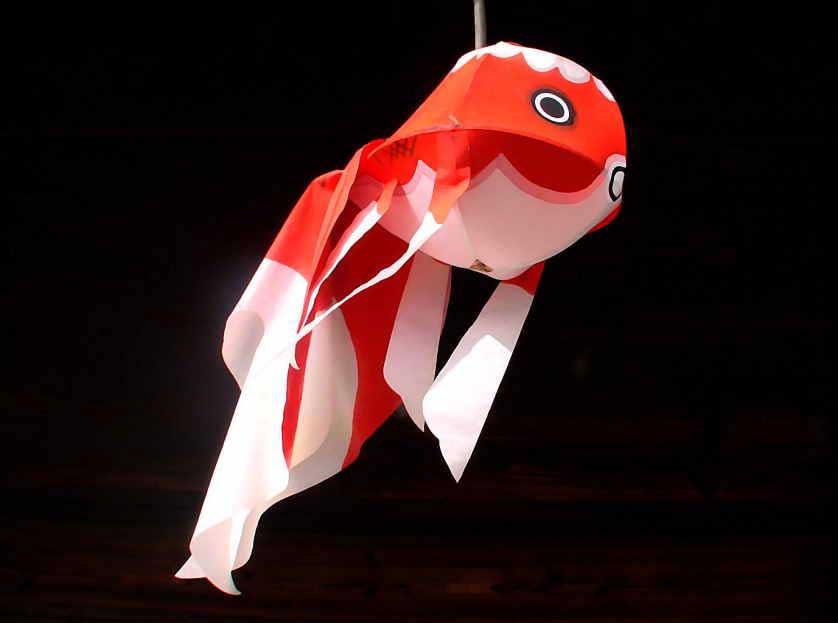
Kingyo Chochin lanterns, unique to Yanai in Yamaguchi Prefecture.
Kingyo Chochin lanterns, unique to Yanai in Yamaguchi Prefecture

© GoodsFromJapan.com